The Ronzeil Large Slatmill is a self-powered treadmill built for dogs, and after I assembled mine solo from the Ronzeil kit in about an hour in my garage, it became the machine behind every Kai's Run conditioning session on the Emerald Coast.
Ronzeil dog treadmill review: the short version
The Ronzeil Large Slatmill is a well-made, self-powered dog treadmill. No motor, no cord, and the dog sets every step of the pace. It took me about an hour to build alone, the legs are the only fiddly part, and the clear plexiglass guard rails and built-in pedometer are the two features that earn their keep for conditioning work.
What this review covers: the unboxing, the build, the setup, and what the mill does under a dog. What it cannot cover yet is long-term wear. The mill is months old, not years. Kai's Run is a Ronzeil affiliate, so a purchase through our link earns a commission - the disclosure sits next to the link at the bottom of this post.
| What I found | |
|---|---|
| Power | None needed. The dog drives the slat belt. |
| Build time | About an hour, solo, on a garage floor |
| Hardest step | Getting the legs square. I reset them three times. |
| Best features | Clear guard rails that hold the lane without feeling like a cage, and a pedometer that turns every run into a logged number |
| Portability | Heavier than it looks, but it rides in a truck bed and sets up on a driveway in minutes |
Why a slatmill and not a motorized treadmill
A motorized treadmill sets the pace. The dog complies. A slatmill flips that relationship. The belt only moves when the dog drives it. The dog owns the speed, the effort, and the stop. The gait stays natural because nothing is dragging the feet backward. A high-drive dog on a slatmill is working, not enduring.
If you want the full mechanics and the safety picture, I wrote that up in what a dog slatmill is and whether it is safe. For how a mill run stacks up against the daily walk, see slatmill vs. walk.
That distinction is the reason Kai's Run exists as a mobile service. I bring the mill to your driveway. Your dog runs at his own pace, under my hands, in his own territory. Nobody fights a machine.
About an hour, three wrong legs
The kit arrived boxed, every part accounted for. Steel rails, the slat belt rolled tight, bearings, bolts, and a printed guide. I cleared the garage floor and laid every part across the concrete. I did the whole build solo, no second set of hands. Then I timed it: about an hour, start to finish. The clock runs on-screen in the build video, mistakes and all.
The legs went on wrong three times. Not once. Three times. Each attempt looked square sitting on the floor. Then I loaded the frame, checked it against a level, and watched one corner sit proud of the rest. So I backed out every bolt, reseated the leg, and torqued it down again. Then a third time. My knuckles found every sharp edge on that frame. By the last pass I could seat those bolts without looking.
Each leg bolts to the frame with a stack of hardware that goes on in one order. Bolt, washer, frame, washer, nut. Miss the order and the leg sits a hair off. A hair off at the foot is a wobble at the deck. The third time, I laid the parts out on the concrete in sequence before I picked up a wrench. That was the pass that held.
You can see the moment it finally held in the video above. I stop narrating and start grinning, because the frame took the load and stayed square.
By the time it stood the garage had stopped being a garage. Cardboard and torn packaging covered one wall. Hardware bags sat lined up on the bench in the order the guide called for them. I worked straight through under a single work light, sorting washers by feel because the bin had tipped once.
With the frame square, I pressed the bearings home and set the rollers. Then I spun the empty belt by hand for the first time. It rolled clean, no catch, no drag. That sound told me the geometry was right before any dog ever stepped on.
Here is the honest part. The build had fewer steps than Ronzeil's own instruction video suggested. Once the frame was true, everything after it moved fast. Slat belt over the rollers, guard panels, safety arch, tension hardware. The belt seated with a flat wooden clatter. Slat against roller, the exact sound it makes under a dog at full stride. It went together cleaner than I expected from a kit this size.
Tensioning the belt was the part that rewarded patience. Too loose and the slats slap. Too tight and the belt fights the rollers and robs the dog of an honest coast. I set it, rolled it by hand, listened, and set it again until it ran quiet and free.
What Ronzeil got right
I am picky about equipment because my name rides on it. Two features earned their place in the first hour of use.
Start with the plexiglass guard rails. They stand up on both sides of the belt and keep the dog centered without closing off sightlines. The dog sees me the whole session. I see the full stride, shoulder to hip, front reach to rear drive. Nobody drifts toward an edge. A high-drive dog wants to track every bird and truck on the street. That clear panel does real work. It holds the lane without feeling like a cage.
The panels are clear, not mesh, so nothing blocks the line between the dog and me. On a mesh cage a dog reads a barrier and starts hunting for the way out. On clear panels he reads open space and settles into the work.
Then the built-in pedometer. Every session ends with a number. Distance becomes a log. The log becomes a progression. Conditioning stops being a feeling and starts being a record, which is the same reason I film every run. A number on the mill and a clip on the phone both turn a good guess into proof.
The safety arch sits over the front of the deck. The harness tether clips to it. A dog that tries to bail sideways meets a soft stop, not the pavement. I clipped it, leaned my weight into it, and felt it hold.
Built, the mill is heavier than it looks and lower than you expect. It rides in the bed of the truck and sets back up on a driveway in minutes. That was the whole point. The machine has to travel. I bring it to the dog instead of asking the dog to come to it.
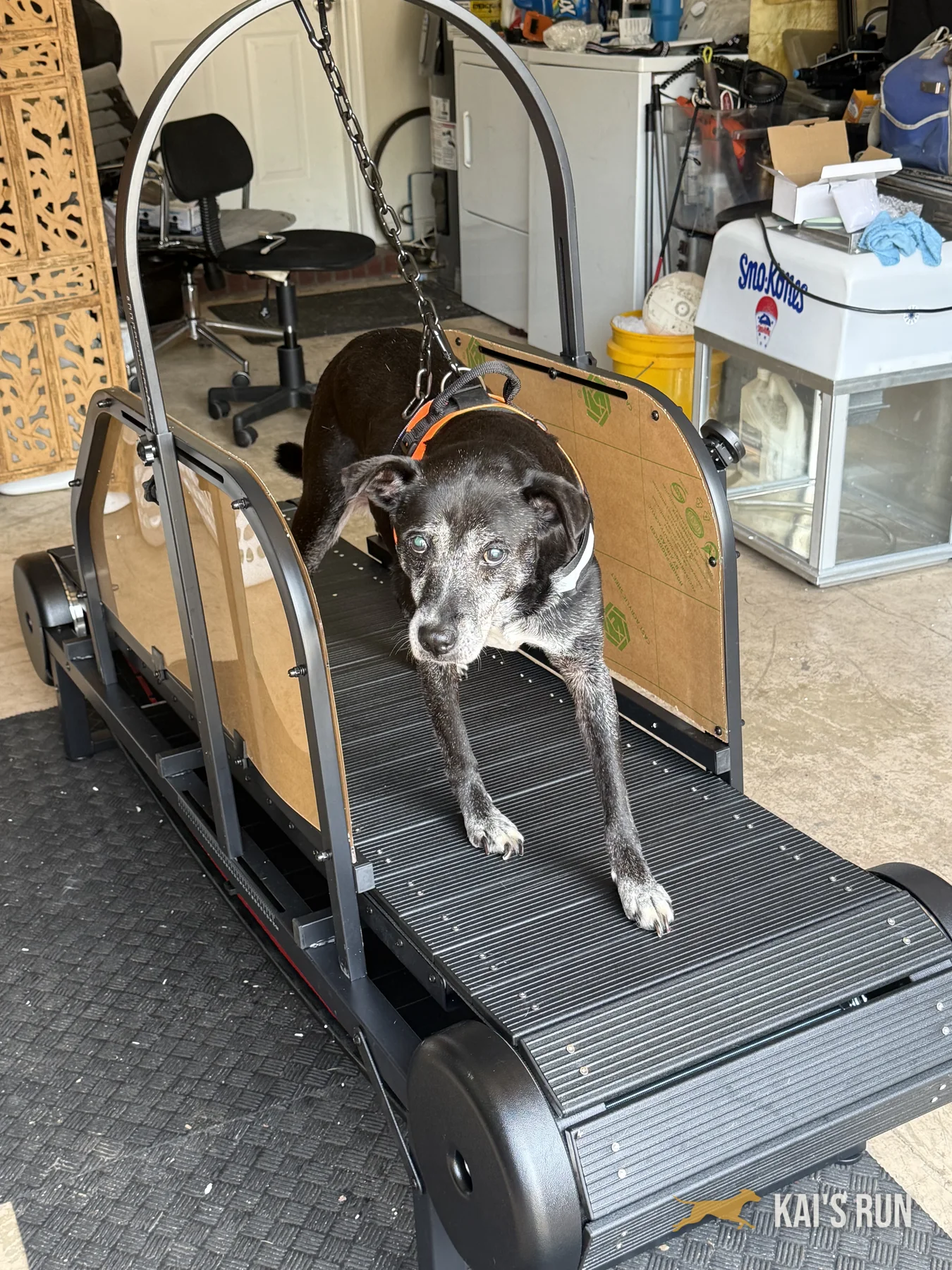
Bailey ran quality control
Before Kai got his turn, the office manager stepped in. Bailey is the senior member of this operation. She does not certify equipment lightly. She put one paw on the belt and felt it roll under her weight. She walked the full length of it. She leaned into the guard rail with her shoulder to test the give. Then she stood on the deck long enough to make it clear the inspection was thorough.
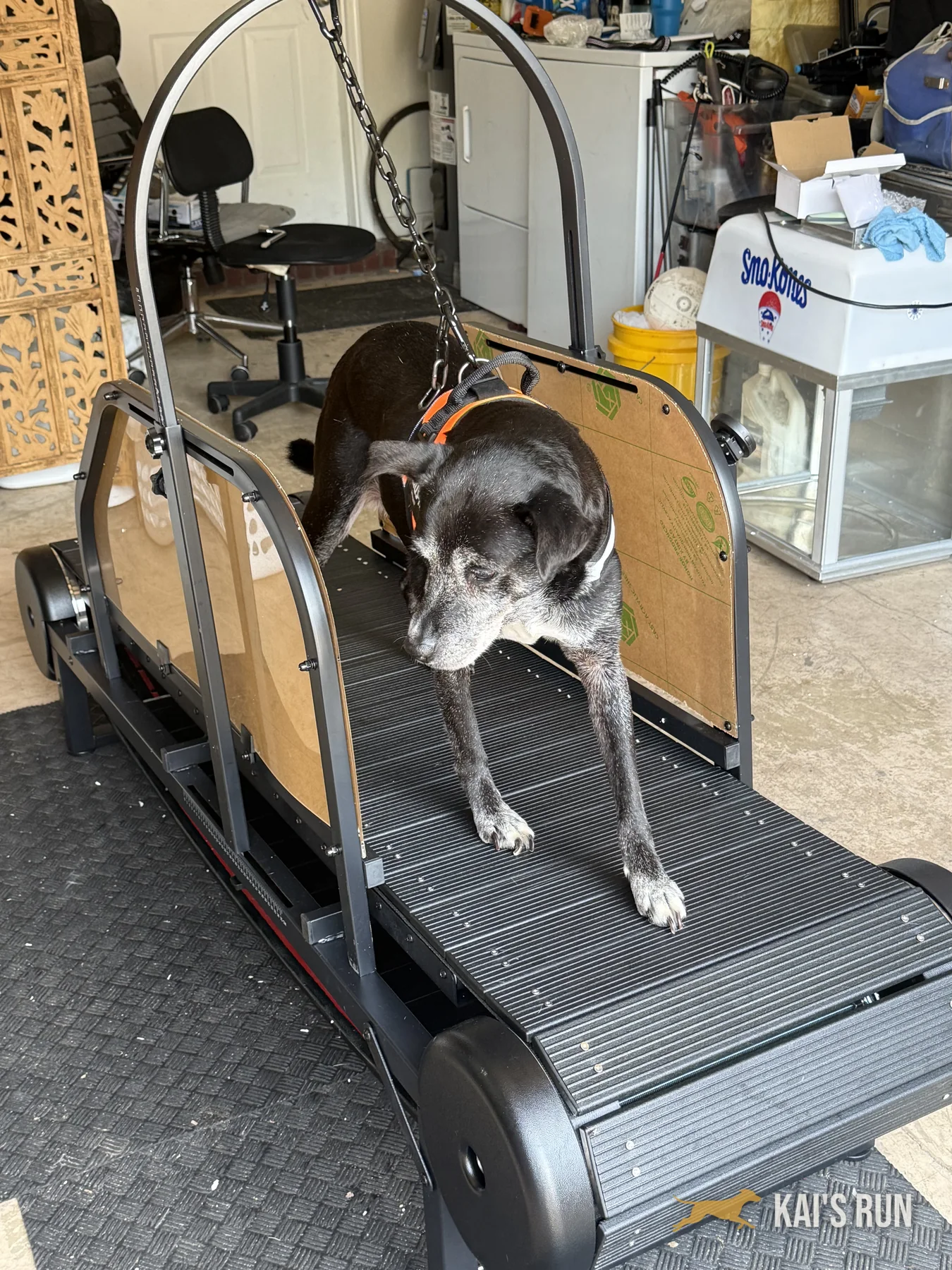
She passed it. Kai runs next.
What I would tell you before you build one
A few things I wish I had known before the first bolt.
Give it a clear, unhurried hour. The whole thing went together in about an hour for me, but rushing the frame is still how you end up redoing it.
The whole machine hinges on the frame. Get it square before you touch anything else. Once the frame was true, the slat belt, guard panels, and tension hardware went on fast.
Expect to reset the legs. I did it three times. Load the frame and check it against a level every time. A leg that looks right on the floor can still sit proud under weight.
Do not let the instruction video scare you. The real build had fewer steps than it suggested.
And know which parts earn their keep. For conditioning, the guard rails and the pedometer are the two that matter.
FAQ
Is the Ronzeil a treadmill or a slatmill? It is a slatmill - a dog treadmill with a belt made of individual slats and no motor. The dog drives the belt with its own stride, so it sets the speed and the stop.
Does the Ronzeil dog treadmill need electricity? No. There is no motor and no cord. It runs anywhere you have a flat, level surface, which is why mine works on a driveway.
How long does the Ronzeil slatmill take to assemble? About an hour for me, working alone. Most of that hour went into getting the legs square under load. Budget an unhurried afternoon so you are not rushing the frame.
Is a slatmill safe for my dog? For a healthy adult dog that sets its own pace, in a fitted harness, on a safety tether, with someone watching every minute, yes. The full checklist, including when a mill is not safe, is in is a slatmill safe for dogs.
How much running does my dog actually need? It depends on drive, age, and conditioning. The dog exercise calculator gives you a daily range before you decide whether a mill of your own makes sense.
What this means for your dog
The mill is built, tested, and mounted for the road. You can read more about the machine itself on the equipment page.
GET YOUR OWN RONZEIL
This is the Ronzeil Large Slatmill, the mill we run at every Kai's Run session. If you want one in your own garage, use the link and code below.
Disclosure: this is an affiliate link. We earn a commission on qualifying purchases at no extra cost to you. We only point people at gear we actually run.
Promo code KAI26 - 18% off your entire order
Kai here. He spent about an hour building me a road that goes nowhere and I have never wanted anything more. Bailey says it passes inspection. Her standards are high and her naps are long, so I trust her. - Kai
Free tool: Dog Exercise Calculator - get your dog's daily exercise target before you decide whether a mill of your own is worth it.
Kai's Run is not taking dogs yet. Join the launch list and you will hear first when conditioning opens in Destin, Fort Walton Beach, Niceville, and the rest of the Emerald Coast.