A dog slatmill is a non-motorized treadmill powered entirely by the dog's own movement - no motor, no minimum speed, no forced pace.
A dog slatmill is a non-motorized treadmill powered entirely by the dog's own movement. Unlike motorized units, a slatmill has no electric motor - the belt moves only when the dog steps forward, and stops the instant they do. The dog controls the pace entirely, from first step to finish. This self-paced work builds sustained aerobic output the way natural running does: the dog chooses the effort, holds it, and every minute on the mill is real work.
The Equipment
What Is a Slatmill?
Paired with the Julius-K9 IDC Powerharness we run on every dog.
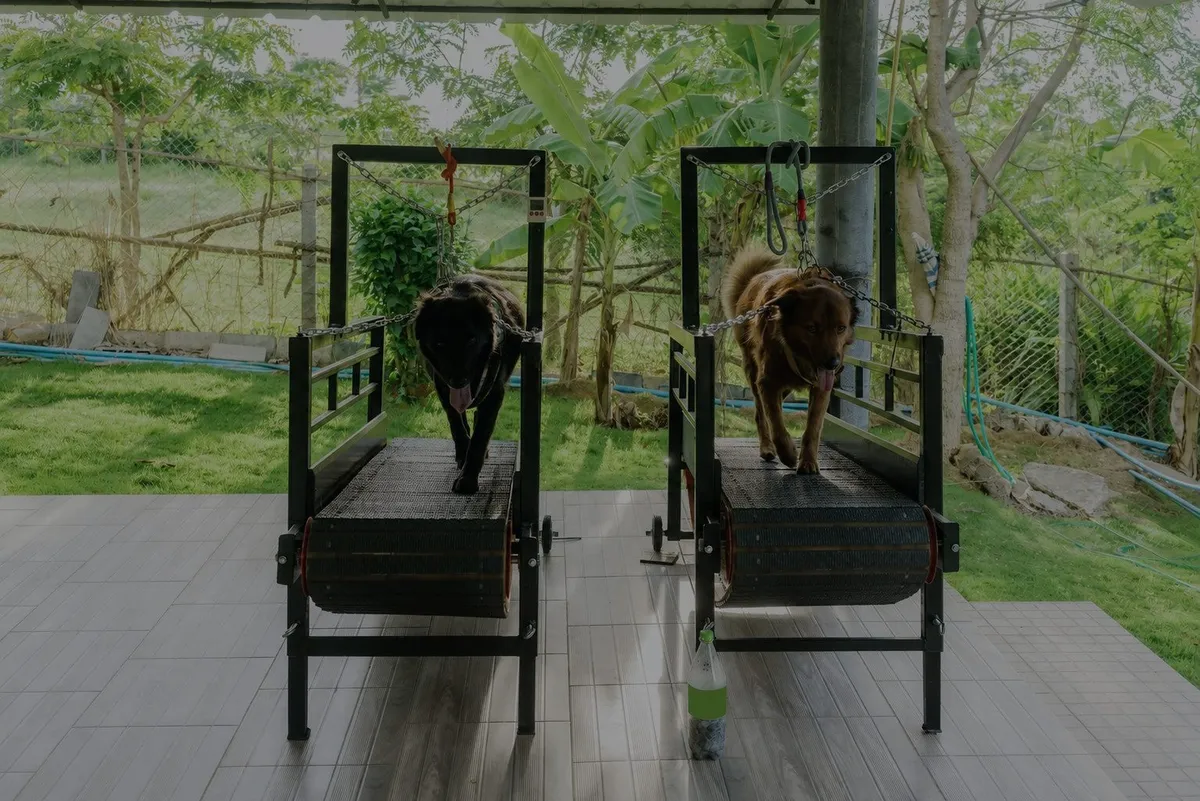
A slatmill is a self-powered treadmill with no motor. The dog controls the pace entirely - every step drives the belt, and nothing forces a minimum speed.
That self-paced work builds sustained aerobic output the way natural running does: focused effort the dog chooses on their own terms, not stop-and-start loops on a sidewalk.
One dog at a time - every Kai's Run session is private.
How a slatmill works
A slatmill is built from individual slats - separate moving pieces linked together - not one continuous rubber belt. When the dog steps forward, their weight and stride push the slats under them. There is no motor. No electricity. The dog's movement is the only power source.
That means the dog can slow down, speed up, or stop whenever they want. Nothing forces a minimum pace. The slats respond to their gait in real time - forward motion creates rotation; stopping creates an immediate stop.
Most dogs figure out the mechanics within minutes. They test it cautiously, then commit once they realize they are in control. Think of it like a hamster wheel designed for dogs - the dog is the engine.
Slatmill vs. motorized dog treadmill
The difference is structural - and it affects safety, biomechanics, and whether anxious dogs will actually use the equipment.
| Motorized treadmill | Slatmill | |
|---|---|---|
| Who sets the pace | The machine - minimum speed is fixed | The dog - every step is self-paced |
| Biomechanics | Dog must match the belt or get pulled | Natural gait at whatever speed they choose |
| When the dog stops | Belt may keep moving - drag risk | Belt stops instantly with the dog |
| Anxious dogs | Forced pace can increase stress | Control builds confidence over time |
Motor treadmills set a minimum speed. The dog has to match it or fight the belt. That is not how dogs naturally move - and it creates safety concerns when a dog fatigues or spooks.
A slatmill lets the dog set their own speed. Hips, shoulders, and spine move the way they would on open ground. When they stop, the slats stop with them. No drag. No machine overriding their decision.
Anxious dogs respond better to equipment they control. A nervous malinois or reactive shepherd who refuses a motorized belt often accepts a slatmill within one session.
This is why we use a slatmill at Kai's Run instead of a motorized unit. See our services breakdown for how sessions are structured. The mill on our truck is the Ronzeil large slatmill, and that page covers why we run it.
What breeds benefit most
Some breeds were built for sustained output - and a slatmill loads that engine the way walks often cannot.
Belgian Malinois - bred for hours of patrol work; most need more structured aerobic output than a neighborhood loop provides.
Rhodesian Ridgeback - bred to run alongside hunters over long distances; Kai, our namesake ridgeback mix, is the reason this business exists.
German Shepherd - high drive and high intelligence; without sufficient output, energy shows up as reactivity or destruction.
Siberian Husky - bred to pull and run for miles; a 30-minute walk is a warmup, not a workout.
Border Collie - physical and mental output both matter; sustained slatmill work engages the body in a way fetch bursts do not.
Vizsla - they need to be moving with you at meaningful intensity, not only nearby on the couch.
But the honest answer is: if your dog is bored, reactive, or destructive at home, they probably need more output than walks can provide - regardless of breed. Read more about why structured runs matter for dogs like yours.
What a session actually looks like
Here is a typical Kai's Run session - no facility drop-off, no other dogs.
We pull up to your driveway in Destin, Fort Walton Beach, Niceville, or Miramar Beach. The slatmill is set up on level ground while your dog watches from a distance they are comfortable with. The unit is climate-controlled, so sessions run year-round regardless of heat - on afternoons when the pavement is too hot for a walk, check conditions for your city and the session becomes the alternative.
Your dog investigates the unit at their own pace. Some sniff every slat. Some hang back for five minutes. Both are fine.
Once they are ready, we fit the Julius-K9 IDC Powerharness and guide them onto the slats for a first pass - slow and short. The goal is confidence, not distance.
Working time runs 15–30 minutes depending on fitness and comfort. We watch gait, breathing, and body language the entire session.
After working time, we cool down - slow passes, water, and time to settle.
You get a written recap and a photo. Questions about fit or frequency? Our FAQ covers the most common ones.
If you're wondering what an actual first session looks like from start to finish, here's a full walk-through.
How a Slatmill Session Actually Runs
The dog steps on and nothing happens. That surprises most owners. There is no motor humming, no belt already moving, nothing to chase or fight. The slats sit still until the dog decides to move them. The first few steps are exploratory - a slow walk while the dog learns that forward pressure turns the belt and stopping stops it. The dog controls the speed entirely. No motor forces a pace. Nothing pulls them along.
From there I watch three things: gait, breathing, and where the dog's attention goes. A dog that keeps glancing back at me is still unsure. A dog that locks its eyes forward has committed. That shift is the moment the session really starts.
The arc is almost always the same. Exploratory walking comes first. Then a rhythm settles in as the dog stops thinking about the equipment. Finally a working pace, where the stride lengthens and the breathing turns steady and deep. Getting there can take two minutes or ten. The dog sets the timeline.
Kai's first session is the one I still reference. He spent the opening stretch testing the slats with one paw, completely unconvinced. Then he leaned into it, found his stride, and refused to come off. That moment - a dog choosing the work instead of tolerating it - is what I look for in every dog now.
What Changes After Regular Sessions
The first thing owners mention is the afternoon. A dog that normally paces or barks through the late hours lies down and stays down after a session. Not sedated - settled. The edge is gone.
Over a few weeks the reports get more specific. The chewing slows. The dog that shredded a bed or worked the back door stops looking for an outlet, because the drive finally has somewhere to go. Dogs that struggled to settle at night sleep harder and wake less. Owners describe a dog that hears a command and actually has the bandwidth to respond to it, instead of one running on a loop of unspent energy.
The change is rarely dramatic on day one. It stacks. A single session takes the edge off for an afternoon. Regular sessions shift the baseline - the dog's default state moves toward calm because the energy that fueled the restlessness is getting spent on purpose, on a schedule the body can count on.
None of this is unique to one breed. It is what happens when a high-drive dog finally gets output that matches its wiring. The behavior owners were trying to train away was usually energy with nowhere to go.
Is a Slatmill Right for Every Dog?
Most dogs are good candidates, but not all, and not at every stage.
Age comes first. We start dogs at a minimum of four months. Younger than that and the body is still too early in its development for structured work.
Health history comes next. Any dog with a cardiac or respiratory history needs vet clearance before we begin - we will ask for it. The point of conditioning is to build a dog up safely, not to push a heart or set of lungs that a vet has flagged.
Two dogs from the same household can both train, but only one at a time, and only from the same home. We never run group sessions and never mix dogs from different households. Every session is private - one dog on the mill, full attention on that dog.
If you are unsure whether your dog fits, ask before booking. A short conversation usually settles it.
FAQ
Is a slatmill the same as a treadmill?
No. A slatmill is dog-powered - there is no motor. The dog sets the pace, speeds up, slows down, and stops on its own. A motorized treadmill forces a pace. A slatmill responds to one.
Is slatmill running safe for dogs?
For healthy adult dogs, yes, with supervision and a proper harness. We require dogs to be at least 4 months old with a current rabies vaccination, and dogs with cardiac or respiratory conditions need vet clearance first. The full breakdown - the self-powered mechanism, the safety protocol, and when not to use one - is in is a slatmill safe for dogs.
How long does a dog run on a slatmill?
Most conditioning sessions are built from short working intervals with rest between them. Total belt time depends on the dog's fitness, age, and the day's heat. A session is built around the dog in front of us, not a stopwatch.
Keep going
Free tool: Dog Exercise Calculator - get your dog's daily exercise target to see whether sustained running belongs in its week.
Kai's Run is not taking dogs yet. Join the launch list and you will hear first when conditioning opens in Destin, Fort Walton Beach, Niceville, and the rest of the Emerald Coast.