High-energy working breeds need 60–90 minutes of true aerobic output daily - sustained cardiovascular work that actually drains the tank, not a stop-start neighborhood walk. Seven breeds sit at the top of that list: the Belgian Malinois, Rhodesian Ridgeback, Siberian Husky, Border Collie, German Shepherd, Weimaraner, and Vizsla. Each was bred for hours of hard work, and each shows a specific breakdown when that work never comes.
Most owners already know their dog has a lot of energy. What they do not know is that "a lot of energy" means something physiologically specific for working breeds - and a walk around the block does not touch it. These dogs were built to run, herd, hunt, or pull for hours. A leash loop barely registers. I run mobile conditioning sessions for exactly these dogs across the Emerald Coast, and the pattern is the same in almost every driveway I pull into: a good dog, a tired owner, and an animal that is still carrying a full charge at 9pm.
If you want the numbers for your own dog, the dog exercise calculator gives you a daily target based on breed and age. But first, here are the seven breeds I see struggle most when they are underloaded - and what each one actually needs.
The seven breeds that need more than a walk
Belgian Malinois
Bred to do: patrol, protection, and bite work that runs for hours without a break. This is the dog military and police units reach for when they need an engine that does not quit.
Daily need: 90–120 minutes of structured, high-intensity work - and a real job for the mind on top of it.
A Malinois on a leash loop is underloaded from the first step. When that drive has nowhere to go, it shows up as reactivity, spinning, pacing, and destruction - not because the dog is poorly trained, but because the engine never gets into gear. The Malinois I condition settle faster than almost any breed once you actually load them. The problem is never willingness. It is that no walk on earth is long or hard enough to satisfy the animal.
Rhodesian Ridgeback
Bred to do: run alongside hunters across long distances in African heat and rough terrain, then hold big game at bay. Endurance and independence in one frame.
Daily need: 60–90 minutes of sustained movement, with heat management built in.
Kai - our namesake ridgeback mix and the reason Kai's Run exists - taught me how this breed hides its needs. Ridgebacks look calm until they are not, and "calm" after a walk usually means they are storing energy for later. You can read Kai's full story here. What I see in sessions is a dog that paces itself beautifully once it has room to actually work - and that goes quietly restless in a house when it does not.
Siberian Husky
Bred to do: pull sleds for miles across frozen terrain, at a steady working trot, all day.
Daily need: 60–120 minutes of sustained aerobic output at meaningful intensity.
For a husky, a 30-minute walk is a warmup, not a workout. The failure mode here is loud and unmistakable - digging, escaping, and the vocal complaining every husky owner knows. Owners tell me their fence is a suggestion. That is not stubbornness. That is a dog built to cover ground looking for the ground it was promised. On the Gulf Coast the heat compounds it, so timing matters as much as intensity - check the too hot to walk tool before any midday session with a double-coated breed.
Border Collie
Bred to do: gather and move livestock with intense focus for hours, reading a handler and a flock at the same time.
Daily need: 60–90 minutes of physical work plus deliberate mental load - both, every day.
Fetch bursts engage the brain briefly but do not load the cardiovascular system the way sustained running does. A border collie with an underworked body and an overloaded mind is the classic recipe for obsessive behavior - shadow chasing, light fixation, nipping at heels, circling. In sessions, the collies that get sustained aerobic work first are far easier to satisfy mentally afterward. Drain the body, and the busy mind finally lets go.
German Shepherd
Bred to do: herd, guard, and perform in the same package - high drive married to high intelligence.
Daily need: 60–90 minutes of structured work with a clear beginning and end.
Without sufficient output, a shepherd's energy redirects into guarding behavior, barking at every trigger, and furniture damage. Shepherds do not want an aimless amble around the block - they want a job with a shape to it. The shepherds I work with respond to structure almost more than to duration. A defined session they can complete does more for their heads than twice as long spent wandering.
Weimaraner
Bred to do: hunt all day alongside a handler, pointing and retrieving across open country.
Daily need: 60–90 minutes of hard aerobic work, done with you, not near you.
A weimaraner who has not been properly exercised is not lazy - that dog is waiting for the job that never came. They bond tightly and need to move at real intensity, not only share a room. The under-exercised failure mode is separation anxiety and household destruction that owners often misread as a training problem. It is usually an output problem wearing a training costume.
Vizsla
Bred to do: hunt and point as a close-working, all-day gundog - the original velcro dog.
Daily need: 60–90 minutes of sustained aerobic contact with their person or a structured outlet that mimics it.
A vizsla on the couch after a short walk is a dog that will find another outlet, and it will not be the one you would have chosen. Counter surfing, chewing, and a nervous, whining edge are the tells. What I see is that once a vizsla gets a genuine sustained burn, the velcro clinginess eases too. The neediness is often unspent drive looking for a target.
The breeds at a glance
| Breed | Bred to do | Daily need | What under-exercise looks like |
|---|---|---|---|
| Belgian Malinois | Patrol and protection work for hours | 90–120 min, high intensity | Reactivity, spinning, pacing, destruction |
| Rhodesian Ridgeback | Endurance running beside hunters in heat | 60–90 min sustained | Restlessness, stored energy, evening pacing |
| Siberian Husky | Pulling sleds for miles at a steady trot | 60–120 min aerobic | Digging, escaping, vocalizing, fence-testing |
| Border Collie | Herding livestock with intense focus | 60–90 min body + mind | Shadow chasing, nipping, obsessive circling |
| German Shepherd | Herding and guarding, high drive | 60–90 min structured | Guarding, barking, furniture damage |
| Weimaraner | All-day hunting with a handler | 60–90 min aerobic | Separation anxiety, destruction |
| Vizsla | Close-working all-day gundog | 60–90 min sustained | Counter surfing, chewing, nervous whining |
If your dog is a purebred version of one of these, the target is clear. Most dogs I see are not. So here is how to figure out what a mixed dog actually needs.
How to read a mixed-breed's drive
Most dogs on the Emerald Coast are mixes, and most owners guess at their needs from looks alone. Looks lie. A dog can carry ridgeback ears and husky energy, or shepherd coloring and couch-dog drive. You do not read a mixed breed by its face. You read it by its behavior.
Here is the practical method I use in a first session.
Watch what it does with an empty afternoon. A dog with real working drive cannot leave a quiet hour alone. It patrols, it re-checks windows, it invents jobs. A lower-drive mix genuinely settles. That difference tells you more than any DNA panel.
Look at the recovery, not the burst. Any dog can sprint after a ball. What matters is whether it wants to keep going after five minutes or taps out. Working-breed drive shows up as stamina and a request for more - not one explosive burst and done.
Name the two strongest breeds you can see, then plan for the higher-drive one. If you suspect husky and lab, plan for the husky end of the range. Underestimating drive is the mistake that fills my calendar. It is far easier to scale a session down than to undo weeks of an underworked dog rehearsing bad habits.
Factor in age honestly. A high-drive dog in adolescence is a different animal than the same dog at five. If yours is between roughly six months and two years, the dog adolescence phase is likely amplifying everything you are seeing. For a full framework on matching output to your specific dog, how much exercise does my dog need walks through it.
Why more walking isn't the answer for these breeds
When a working dog is bouncing off the walls, the instinct is to walk it longer. Add a lap. Go twice a day. For these seven breeds, that rarely fixes anything, and I watch owners burn out trying.
A neighborhood walk is low-intensity and stop-start by design. Your dog pauses at mailboxes, pulls toward stimuli, sniffs a hedge for minutes, and reacts to every dog, bike, and truck in range. That is mental processing, not cardiovascular loading. Heart rate spikes and drops. Muscles work in bursts. The aerobic engine never holds a steady burn - which is the exact thing a working breed was built to sustain.
Walks have a real place. Recovery, enrichment, sniffing, bonding - all valuable. But they are not a substitute for structured aerobic work when the dog was bred for hours of output. Doubling the length of the wrong tool does not turn it into the right one. I break down that difference in depth in why structured runs matter, and if you are in the daily fight to drain a wired dog, how to tire out a high-energy dog covers what actually moves the needle. There is also a side-by-side in the treadmill vs walk comparison if you want to see the gap laid out.
On the Gulf Coast there is a second problem: for half the year it is genuinely too hot to walk your dog at the hours that fit most schedules. A working breed still needs its full output on a 95-degree day. Walking cannot deliver that safely. Something else has to.
What actually works
The Equipment
What Is a Slatmill?
Paired with the Julius-K9 IDC Powerharness we run on every dog.
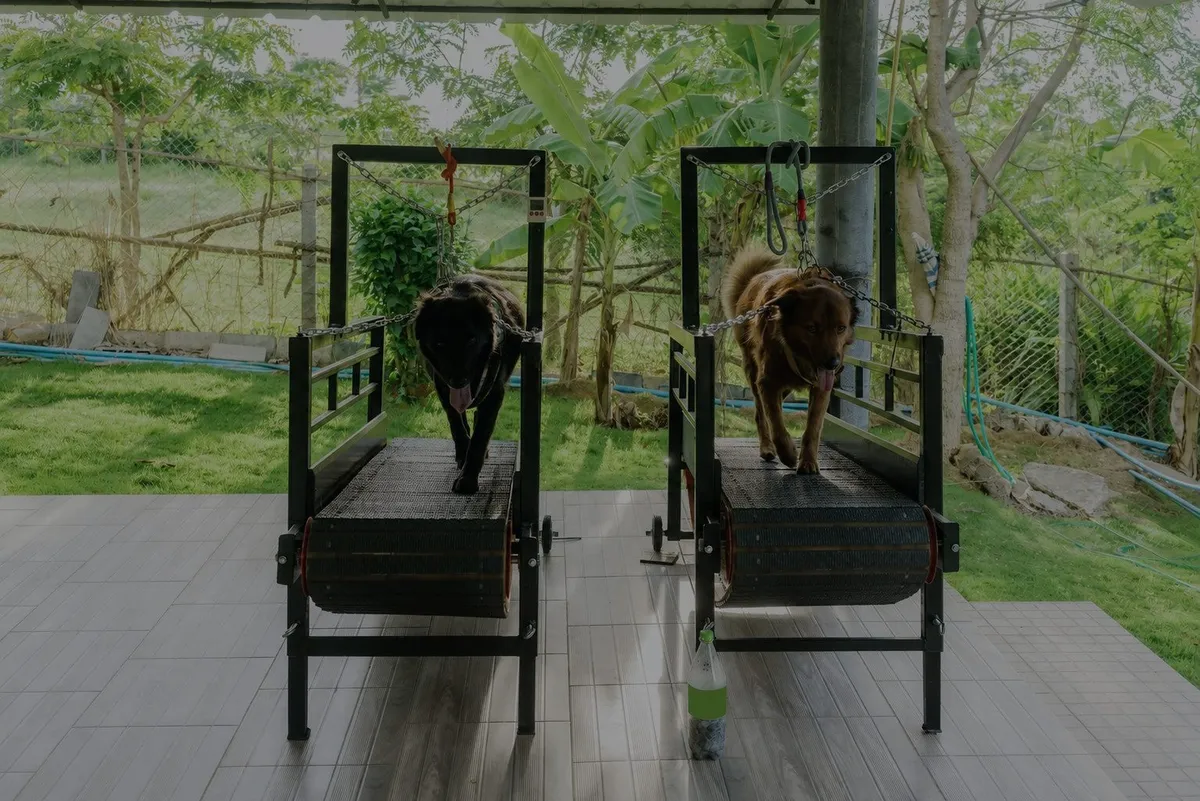
A slatmill is a self-powered treadmill with no motor. The dog controls the pace entirely - every step drives the belt, and nothing forces a minimum speed.
That self-paced work builds sustained aerobic output the way natural running does: focused effort the dog chooses on their own terms, not stop-and-start loops on a sidewalk.
One dog at a time - every Kai's Run session is private.
The answer is structured, sustained, self-paced running - and for most owners of these breeds, that means a slatmill. If the tool is new to you, what is a dog slatmill explains how it differs from a motorized treadmill and why the dog sets its own pace.
After 20–30 minutes of sustained slatmill work, most high-drive breeds show a completely different behavioral signature than they do after any walk. They eat calmly. They settle in the evening. They sleep deeper, and they show less reactivity at their usual triggers the next morning. That is what loading the aerobic system actually looks like - the tank finally reads empty.
Fetch, flirt poles, and swimming are useful complements, not replacements. Fetch is anaerobic burst work. A flirt pole is intense for thirty seconds and then done. Swimming needs daily water access most owners cannot sustain. These tools help between sessions. They do not deliver the sustained cardiovascular output a working breed needs several times a week. To sanity-check whether your dog is actually at a healthy working weight, the body condition score tool is a quick gut check.
Bring the slatmill to your driveway
This is what Kai's Run is being built for across our service area on the Emerald Coast: private, structured slatmill conditioning at your home, matched to your dog's breed, drive, and age. No facility drop-off. No other dogs. It is not taking dogs yet, so until it does, the plan above is yours to run.
Frequently Asked Questions
How do I know if my dog is one of these high-energy breeds? Start with what you can see - the two strongest breeds in the mix - and plan for the higher-drive one. Then watch behavior over an empty afternoon. A working-drive dog cannot leave a quiet hour alone, and it asks for more after exercise instead of tapping out. Looks alone are unreliable, so weight your read toward what the dog does, not what it resembles.
Isn't 60–90 minutes of exercise a day too much? For most companion breeds, yes. For the seven breeds here, it is the baseline they were bred for, not an extreme. The key is that it needs to be sustained aerobic work, not stop-start walking - 30 minutes of real output beats two hours of sniff loops. Quality of load matters more than raw time on leash.
Can I walk my dog longer instead of using a slatmill? Rarely, for these breeds. A walk is low-intensity and stop-start, so the aerobic engine never holds a steady burn. You can double the distance and still leave a working dog under-worked because you are scaling the wrong type of exercise. Structured sustained running loads the cardiovascular system in a way walking cannot.
What happens if a working breed doesn't get enough exercise? The unspent drive redirects, and each breed has its own tell - digging and escaping in huskies, obsessive circling in border collies, guarding and barking in shepherds, separation anxiety in weimaraners. Owners often read these as training problems. Far more often they are output problems, and they ease once the dog is properly conditioned.
Is it too hot to exercise my dog on the Emerald Coast? For much of the year, midday walking is genuinely unsafe here, especially for double-coated breeds like huskies. But a working dog still needs its full output on a hot day. That is exactly why a shaded, self-paced slatmill session works when the pavement does not - check the too-hot-to-walk tool before any warm-weather session and plan around the heat, not through it.
My dog is a young adolescent and impossible right now - will conditioning help? Usually, yes. Adolescence amplifies everything a high-drive breed already carries, and an underworked adolescent rehearses bad habits daily. Draining the body with structured work first makes the training and settling far easier. It does not replace training - it makes training possible.
Keep going
Free tool: Dog Exercise Calculator - get the daily output target for your breed and age, so you know how far a walk leaves a working dog short.
Kai's Run is not taking dogs yet. Join the launch list and you will hear first when conditioning opens in Destin, Fort Walton Beach, Niceville, and the rest of the Emerald Coast.